''Rosas Danst Rosas''
The professional dance work chosen to explore in detail & review about.
Choreographer: Anna Teresa De Keersmaeker
 Created By:
Adriana Borriello, Anne Teresa De Keersmaeker,
Michèle Anne De Mey, Fumiyo Ikeda
Created By:
Adriana Borriello, Anne Teresa De Keersmaeker,
Michèle Anne De Mey, Fumiyo Ikeda
Danced By:
Anne Teresa De Keersmaeker, Moya Michael, Cynthia Loemij,
Sarah Ludi, Samantha Van, Wissen Tale Dolven, Moya Michael Sandra Ortega Bejarano, Elizaveta Penkova, Sue-Yeon Youn
Accompaniment (Music): Thierry De Mey, Peter Vermeersch
Musicians: Thierry De Mey, Walter Hus, Eric Sleichim, Peter Vermeersch
Set Designer: Anne Teresa De Keersmaeker
Light Designer: RemonFremont
Costumes Designer: Rosas
Dance Structure: 4 sections
Productions: 1983-Rosas, Kaaitheater1993-Rosas, La Monnaie / De Munt
Premiere of Live Performance : 6 May 1983, Théâtre de la Balsamine, Brussels, as part in the Kaaitheater festival.
Filmed Version: Made in 1997
Director of the Film: Thierry De Mey
Rosas Danst Rosas Review
Anna Teresa De Keersmaeker choreographed 'Rosa Danst Rosa' in the style of contemporary dance. Performed originally by 4 dancers and is now preformed by a cast of 10 rotating dancers to the accompaniment created by Thierry De Meyand Peter Vermeersch, Rosas, Danst Rosas was first performed live in 1983 and then went on the premier the film of 'Rosas Danst Rosa' on the 6th of May 1983 in Théâtre de la Balsamine in Brussels as part of the Kaaitheater festival.
The starting point and stimulus to Rosa Danst Rosa is the 'Music-Dance relationship' and the theme
of the dance is 'Human Behaviour and rage'.
The filmed version of 'Rosa, Danst Rosa' is set in a school in Belgium, making it 'Site specific' staging. The performance takes place in the corridors and classrooms of the large empty school. The film shows the windows, door and wall frame repeatedly remind us and showing us that it is set in a school and large structured building. The lighting in the film is lite from ht e natural light through the windows and doors. The filmed version is 1 hour and 40 minutes long.
The live dance is performed on a stage and is 8 and half minutes long. The costumes were based on a distinctive female look, so they were full skirts, tomboyish boots. They are serious-looking women
with civilian haircuts, wearing loose grey tops and skirts and brown, utilitarian brown plimsoles.
Choreography in 'Rosa Danst Rosa'
The dance style for 'Rosa Danst Rosa' is choreographed in the style of post modern with pedestrian actions and repetitive gestures. It also energetic and dynamic.
The dance is sectioned into 8 parts. The different sections represent different times during the day.
Section 1 – Moving In
This is represents the nighttime.
Section Two - Floor
This section is trying to represent the morning time.
This section is all about exploring the floor using contrasting dynamics with an emphasis on suspension, fall & release.
Key actions used are roll, push up on the elbows, arch, fall, always using the breath as a way into and out of the movement.
At first, the actions appear repetitive, with the same movements repeated over and over again, but this is not the case.
Focus carefully on the use of the arms and you will see that tiny details change all the time.
Fragmentation is used to great effect towards the end of the section.
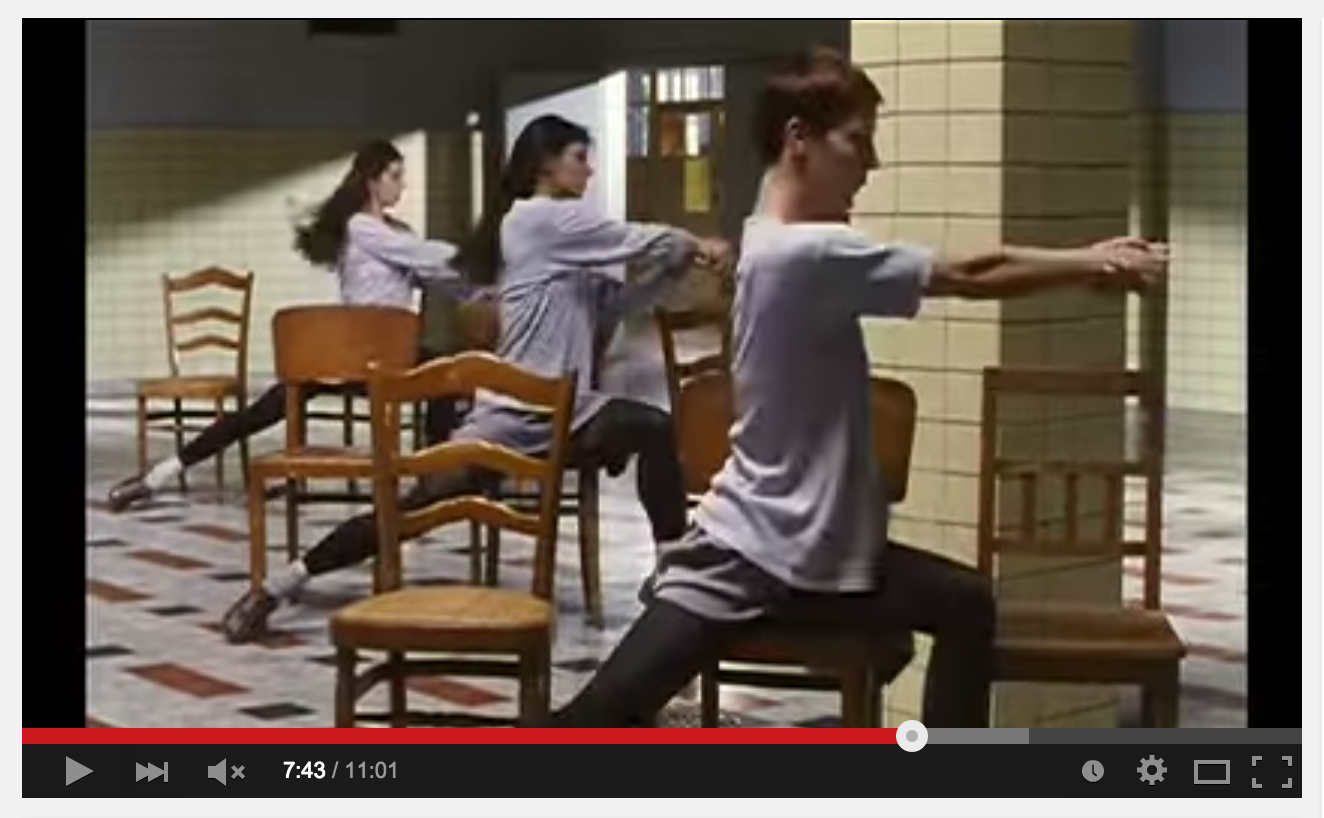
Section 3 - Chairs
This section is trying to represent the afternoon.
The action content can be divided into 4 main motifs and these are fragmented and re-ordered throughout this 8 minute section, using a large amount of accumulation and relationships which together create a complex structure.
The 4 motifs are introduced first before building in complexity and intensity.
Motif A: Cross legs. Hand to hair, bring down side of head, over ear, to neck. Pull top off shoulder, pause, replace, pause, look over R shoulder. ‘Knowing’ nod with slight smile. Face front.
Motif B: Uncross legs. Throw arms across body to L, L arm holds top of chair, R arm to L hip. Suspend, fall forwards arms folded across stomach, head falls last. Rebound to upright, L arm crosses under R, R arm on knee.
Motif C: Hands behind head, elbows raised to sides. R hand to breast, flop forwards, punch R arm down. Rebound. Backs of hands pass under chin one after other, drop forwards, replace. Arch, hand to chin & head turn to R, drop palm in lap. Upright, R hand over head.
Motif D: Twist/lunge to L throwing arms and clasping hands in front. Throw clasped hands across body to R, simultaneous drop forwards. Upright, arch, hands between thighs.
Section 4 - Building
This section is about being tired and going into overdrive.
The movement used in Section Four is a paroxysm of dancing, dancing without counting, over and over again.
Section 5 – Glass Interiors
This section follows seamlessly from ‘Building’ as a continuation .
It is primarily focused on relationships, making good use of fragmentation which creates a canon effect as well as unison, counterpoint and grouping different sets of dancers together.
The result is a section where dancers move in and out of these relationships fluidly and it can be hard to spot where the change has happened.
The movement often matches the accents and dynamics of the music.
Section 6 - The Lying Down
Section 7 – Inner Court
Section 8 - Coda
The accompaniment mean the music/soundtrack of the dance.
The accompaniment in 'Rosa Danst Rosa' is electronic, percussive and give a metallic rhythm feel.
The accompaniment is connected and linked in the paces and energy of the dance, this is because the music and choreography were written together during the course of the creative and decision making process. The tempo of the music is upbeat and energetic but changes throughout the pieces, this is to keep the audience and viewers interested throughout the performance and also fits in with he climaxes and highlights of the dance. The connection between the music and choreography also explains the unison of musical and choreographic energy.
Camera Shots in 'Rosa Danst Rosa'
The camera shots and angles used and created throughout the filmed version of 'Rosa, Danst Rosa' are over the shoulder shots, extreme close up angles, medium shots and panning shots.
A special effects that is used in 'Rosa Danst Rosa' is 'Inter Cutting'. Inter Cutting gives the impression that there are more dancers in the performance.
For example the camera man uses the 'extreme close up shot' to highlight single parts of the body.This camera shot is effective as it draws attention to small gestures performed by the dancers too. This also helps with showing different emotions.
Example of a Panning Shot in 'Rosa, Danst Rosa':
Panning Started from 1 dancer...
Ending with panning out to 3 dancers...
Why this the Panning shot is effective?
Panning shots allow the audience to see the view of a motion similar to someone that is shaking their head. Just like the digram/image below.
Example of the 'Over the shoulder' Shot from 'Rosa, Danst Rosa':
Personal Views
I enjoyed researching and learning more into Rosa Danst Rosa, I did not find it boring or
uninteresting even though I have already studied the professional work in GCSE Dance.
The most interesting part I found was looking at the staging and the building the dance with set in. I thought making the set 'Site specific' was very interesting for the audience and the viewer watching it, When watching it was wanting to watch more and looking forward to the next scene.
My favourite section was "Section Three - Chairs". I thought the choreographic movement in this sections was very simple but the choreographer, Anna Teresa De Keersmaeker made it work well and choreographed to make it look difficult, complicated and effective. I also thought this sections worked very well and the best with the music. This is because the arm movement and head movement fitted in the beats and sounds of the accompaniment.